.webp)
Based on a talk delivered at the EFB Users Forum 2026

Ask any pilot how many apps they open in a single turn and watch them start counting. Charts in one app. Weather in another. Performance, flight plan, NOTAMs, turbulence - each in its own silo. The EFB community raise "app fatigue" at every opportunity, and the request is always the same: give us fewer apps. Three or four instead of fifteen.
It's a reasonable thing to ask for. But it's solving the wrong problem.
The Phone in Your Pocket Already Solved This

Here's the part that doesn't add up. The average smartphone has more than 80 apps installed, and people open 9to 11 of them every single day. That's far more than any cockpit. And yet nobody complains about app fatigue on their phone. Nobody is begging Apple or Google to cut them down to four apps.
Why?

One button.
The share button.
We tap it dozens of times a day without thinking about it. It's what lets you start something in one app and finish it in another - find a restaurant in your browser, tap share, and Maps opens with directions already loaded. You never retype the address. You never lose your place.
That button is the reason your phone is an ecosystem and not just a pile of icons. It's why we don't want only four apps on our phones -because each app does the one thing it's best at, and then hands off cleanly to the next. The handoff is the whole point.
That's exactly what the cockpit is missing.
The Cockpit's Share Button Has a Name: ARINC 840A
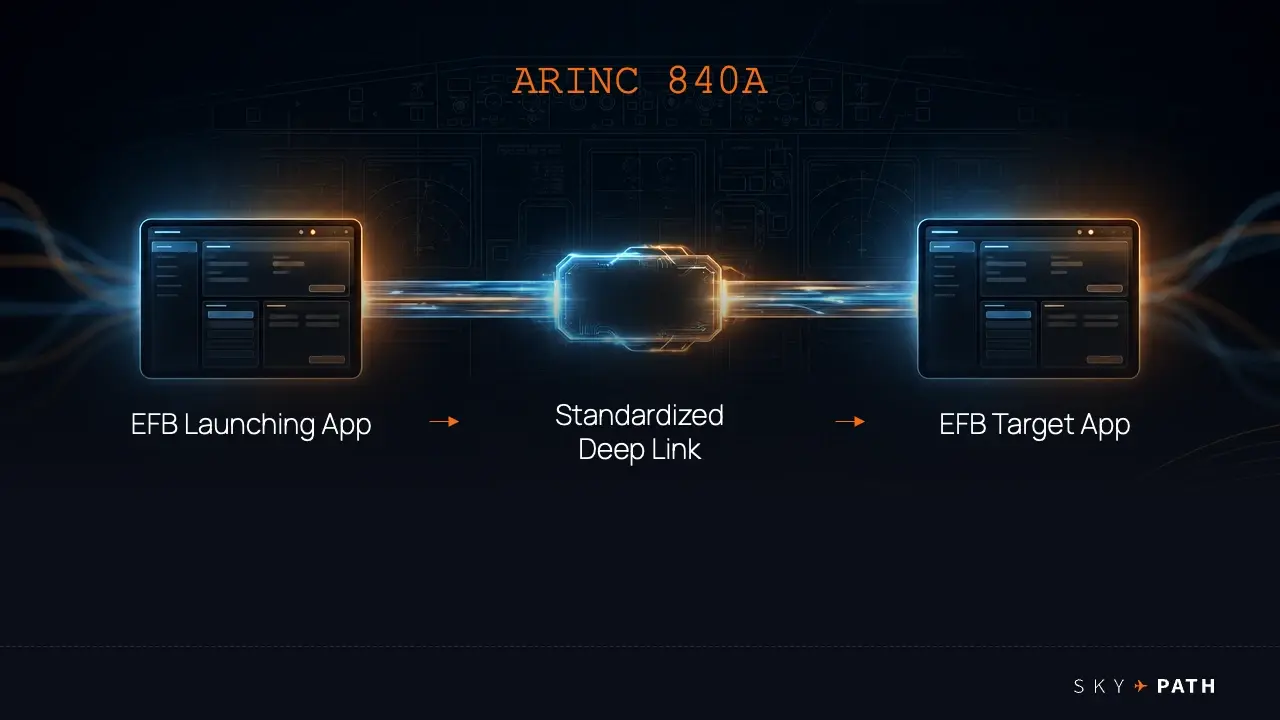
The good news is that the EFB world doesn't have to invent this. The standard already exists.
ARINC 840A defines a standardized URL-scheme protocol - deep linking - between EFB apps on the same tablet. When one app launches another, the full flight context travels inside the link: flight number, origin and destination, route string, aircraft registration, times. The receiving app opens with everything already loaded.
No retyping. No fat-finger errors. No context loss.
If you've ever tapped a link in a text message and watched the right app open with the right thing ready to go, you already understand 840A. It's the same mechanism your phone uses every day- just with a vocabulary built for aviation.
We Didn't Just Talk About It. We Shipped It.
SkyPath is the first app to implement ARINC 840A, and it's already in pilots' hands through our partners' apps.
A pilot is in their EFB app and sees their flight. They tap "SkyPath." SkyPath opens instantly -route, waypoints, and aircraft already loaded, turbulence map ready. No typing, no searching, no setup.
And the engineering behind it is genuinely simple, which is the point. For the launching app, it's a single step: send a link with the flight details attached. For the receiving app, us, it's two standard, well-documented steps: register with the operating system to handle the link, then read the flight details and show the data.
That's the entire integration. One step on one side, two on the other. This is what we're asking EFB vendors to consider - and it really is this small.
Why This Matters for the EFB Ecosystem
An integration-first cockpit changes the math for everyone:
· For pilots - fewer apps to master, less cognitive load, and no retyping flight numbers across a dozen screens. Time goes back where it belongs.
· For airlines - the tools you've already deployed start working together, extending the value of existing investments with no new hardware and no workflow changes.
· For the industry - when data flows between apps instead of sitting in silos, everyone starts seeing patterns no single app could reveal on its own.
The cockpit doesn't need fewer apps. It needs apps that talk to each other. The standards to make that happen already exist, waiting to be adopted.
Let's Build the EFB Ecosystem Together
We built SkyPath to share, because sharing is caring - and because an ecosystem only works when its members commit to the handoff. If you're an EFB vendor, an airline, or a developer who wants to connect, we'd love to talk.
Reach out to us at contact@skypath.io, or explore the integration docs at docs.skypath.io.
Smartphone stat source: data.ai& Statista via BuildFire, 2026; Techjury, 2025.
%20(3000%20x%202250%20px).webp)


.webp)